same diff
2 Likes
Well, leaving out a lot of the stuff specific to imagining and portraying tiny things, the main point is that while science people can go on endlessly over some kinds of data display, and most can be very discerning about good (science) writing, often their interpretations of images are just underthought or even absent. The visual system works so quickly, it can be really hard to get past your first impression. Thus, uncritical collection, display and interpretation of images.
As a start I go specifically into the differences between digital image detection and display (two massive jumps) and primate image “seeing.” For the systems we use now at least, digital detectors intrinsically resist detecting high contrast jumps. The neurons all the way up in the retina are already wired to detect and latch onto contrast. In digital systems, image collection and processing are discrete steps. We start processing before we even get past our detectors.
Then there’s dynamic range. The detectors we use are typically capable of 16 bits of depth, meaning up to more than 65000 distinct levels of brightness. I don’t recall how many the primate system can reliably detect, but it’s WAY less. More importantly, the dynamic range of the human system (darkest dark to brightest distinguishable bright) is much, much greater than any of these sensors. So, the digital record has a whole bunch more steps spread over a much smaller range of actual intensities. If we just use our images to squish around the resulting data into something that “looks pretty,” we are vastly under-utilizing the tool. For most applications, 16 bits is way too much for what we ultimately display. It’s good to be aware of the caveats and exceptions.
Another whole step is image display. The primate system doesn’t really have this. We worked up some kind of arbitrary ways to do it making assumptions about flat planes and vanishing points, but it’s not that great (eyeballs constantly move, and the sensing part is concave, not flat…etc). Nonetheless, we’ve applied the same logic both to detection and display in our digital systems (sensors and screens are flat grids). All that said, the main stumbling block in this step remains dynamic range and intensity levels. Things are improving, but digital projectors are still typically pathetic in terms of their dynamic range. Then there’s the problem of gradients. The system of projecting light onto a bright colored plane is going to favor the brighter end of the scale. Meaning, if you project a perfect gradient from black to white, what looks like the actual “middle” grey will be shifted towards the black end. A lot of the “gray” levels end up being brighter ones that we can’t distinguish in the projection. This gets even more complex when we talk color images. It sounds overly technical, but every time I hear a speaker say “this isn’t projecting well,” I get aggravated. Things have improved during the zoom era since people are mostly staring at monitors. Although monitor to monitor differences are another thing.
Wall o’ text delivered. Apologies for the simplification of devices I don’t understand as well as others. I guess the point is to get people to slow down their visual system, to improve the data they capture, improve how thoughtfully they display it, and become more critical about interpreting it. It’s my niche educational product.
atmo…
15 Likes
You guys are the worst. Or the best. I dont fucking know.
One thing I do know is that bike fucking sucks and I don’t need a team of experts to prove it. Go post that shit on bikeforums or reddit or some shit.
12 Likes
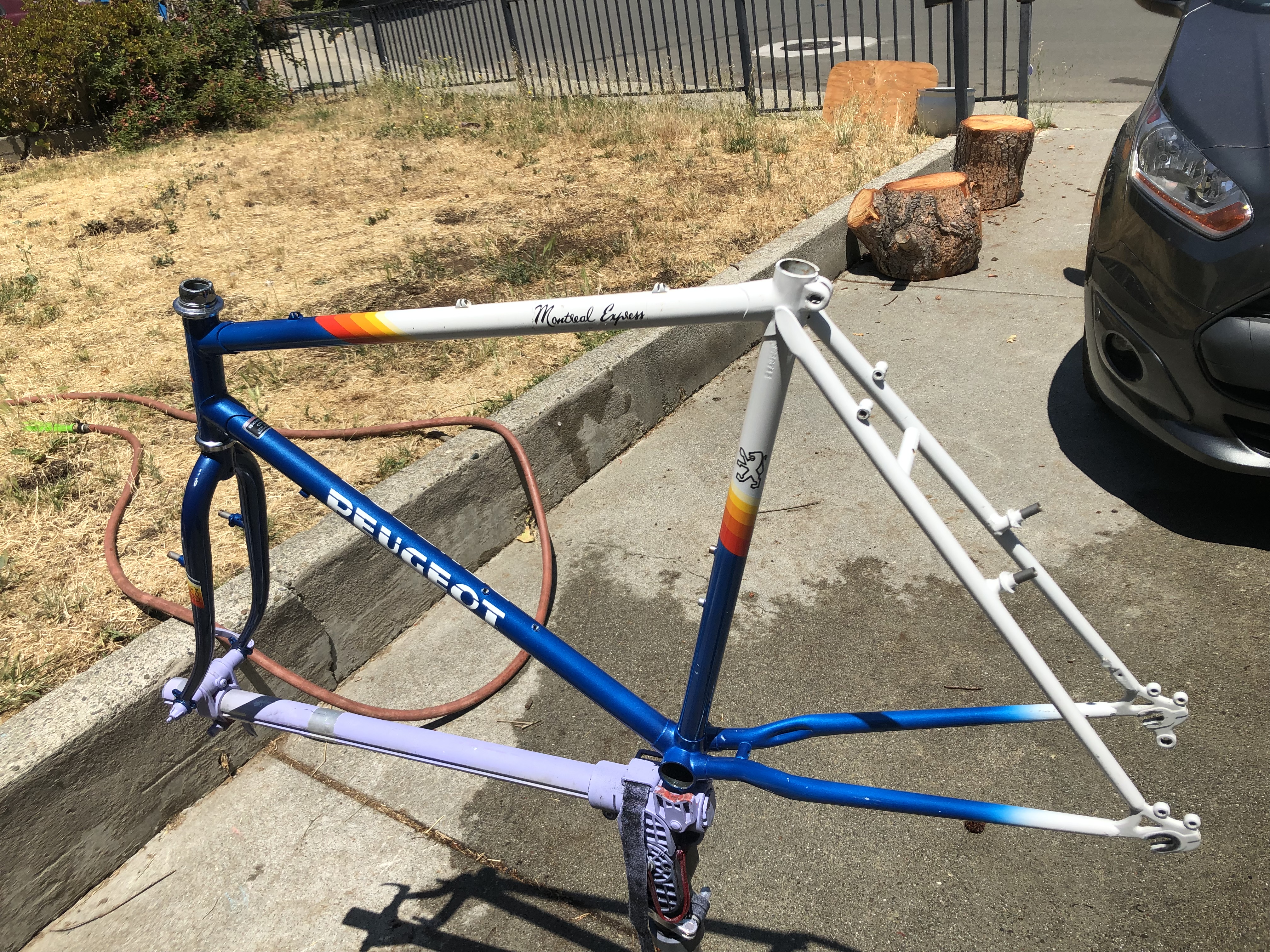
Ceci n’est pas une biek
2 Likes

What sizeway and priceway?
1 Like
What color is it?
10 Likes
Don’t even get them started on the cable housing
2 Likes
The cable housing is several different colors.
3 Likes

Finished this bike for the neighbor. Hopefully we can go on some bike rides. The front shifter is busted so the bike is locked in the middle gear on the front.
3 Likes
That bike is a nice dark silver color.
2 Likes
Green of course.
4 Likes
What made you go with a positive rise stem with a custom geo? Headtube doesn’t look crazy long for AM steerer lengths.
I don’t think you were here for this, but I injured my neck severely 3 years ago and was off the bike for a long time. I even resorted to a recumbent for a while, which was absolutely brutal here in hill country. The pain still varies, although it has been mostly gone for a while. This allows me to take out the spacer and flip the stem as needed.
Oh that’s smart. Sorry about your injury, very happy to hear you can still enjoy the bike. Lots of exposed seatpost is smart given your needs- I bet you would like how Topstone geo and rear “suspension” feels. LMK if you ever want to try a plastic gravel bike.
Yeah the last thing I want is for the expensive bike that I waited a long time for to be unrideable because of my dumb neck.
As far as plastic bikes go: I have tried several. I want to like them and I am not a steel is real kind of person but I find them thunky and generally unpleasant to ride, especially at the long distances I used to routinely ride (and am starting to ride again).
Perhaps if I was a more powerful rider they would make more sense but at 3.5 w/kg I’m not going to win any races. I would love an Aethos in theory, for example, but in practice I’d probably hate it.
2 Likes
perfect word for it
3 Likes
Meh, I prefer different stuff (but I would, right?). Cheap carbon is definitely thunky, and most steel bikes I’ve ridden are clunky, and call it koolaid as y’all usually do, but carbon bikes taught be to appreciate comfort, not boutique steel bikes. I can tell that carbon definitely gets lumped into racing/performance a lot here, which is fair, but not being competitive or lower w/kg is a bad reason to avoid the material- you’re missing out on a lot. I would be very surprised if you found a Synapse or Aethos to be “thunky”. I do love aluminum though- well made aluminum bikes just have that zing.
3 Likes
I wanna say me because deadenders that fit me rarely come up for sale, but there’s already a more vintagey deadender frame in my cellar that I have no idea what I’m going to do with.