Post your fan setup. I feel like a lot of people’s problems with indoor riding have to do with heat regulation. I recently picked up 2 10" “turbo” fans and have them setup on both sides of my trainer, pointed up towards where I normally sit on the bike. Up until then, I had an 18" floor fan that felt like it did fuckall. They not only are better at cooling, but they are way, way quieter.
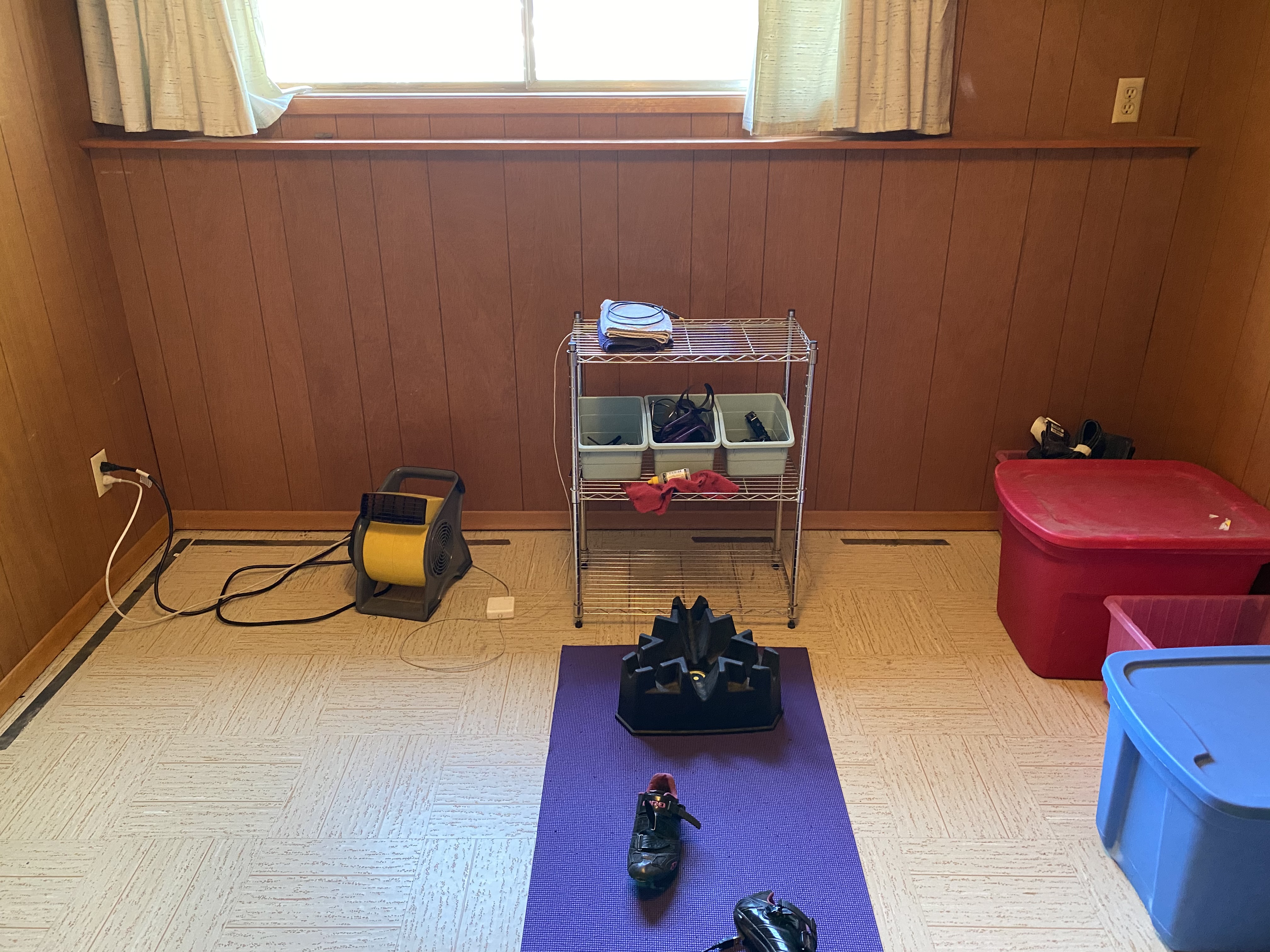
It’s obviously not pointed the right way in that pic, but that’s pretty much what I’ve got going on. I open that big window and then have the fan pointed at me. It’s effective enough that I feel chilly if I’m not really working, but I still overheat when doing harder efforts that last more than a minute or 90 seconds.
IME 2 fans, pointed at you from from each corner, helps a little more. My floor fan kinda just moved air everywhere vs the 2 smaller fans that direct air exactly where you want.
I got these exact ones.
Also, I find that having fans that only hit you while you’re sitting in the position you should be riding in helps you to gravitate towards riding there. If I’m on the tops, I don’t get as much airflow as riding on the hoods in an aggressive position.
1 Like
They just opened 2.7kms of new single track near me so I thought I would make a loop out of it, incorporating a whole bunch more singletrack. To get the elevation tho I needed to do a 30 minute climb which is pretty much granny gear the whole time except for a short bit in the middle that joins the two 15% segments. The last time I rode it, a few weeks back was on the OPEN and I cleaned it, it felt surprisingly easy, despite being rough and loose. This time I dragged out my fully, and man did I suck. I actually had to get off and walk segments I was doing it so hard. Ive never got off and walked up there for any reason other than a momentary loss of traction. Nurse told me my blood pressure was way up after a free health check this week so maybe that’s what it was. Whatever, it sucked. Im off to Google blood pressure.
I can now ride harder for shorter distances and get what feels like a good workout in less time. Thanks team.
5 Likes
2x30’@Z3 today after work.
15 min z2
30min 301 avg
5 min z2
30min 294 avg
10 min cool down
I’m hoping to acclimate to the heat soon so I can start doing at least endurance rides outside.
1 Like
I quit trying to train again, but keeping up with periodization. On rest week this week. Between riding, running, hiking, I was up to 11 hours of activity last week. 6 hours was riding. Gotta work up to those 3-4 mtb ride adventures.
2 Likes
I’m hitting an hour pretty regularly on my 29.5 km commute. Even in the morning now, which is about a 10 minute improvement since I started in Feb.
This morning I was 12 seconds from a PR after what felt like was a pretty chill ride. I have no idea how, but I guess this is what getting stronger feels like?
I might be nearing the theoretical best time, to get home faster I’d have to get super lucky on the lights and traffic AND really go for it on the safe sprints, which as the weather gets nicer and the bike lanes fill up with normies are few and far between.
Just wanted to brag a little. Carry on.
6 Likes
I did another FTP test today, because I’m going to start another training cycle. The results sucked initially since my FTP didn’t change from the last time. Then I realized I had lost about 3 kg, so my w/kg was technically up. I shouldn’t be too surprised, since all I’ve been doing are long rides and no speed work. I don’t know if my fit had anything to do with it, but my hamstrings are feeling a lot more worked than usual.
The good news is that after about 6 months of concerted effort, I’ve managed to flatten my power profile to not look like a track sprinter. Now I’m closer to an all-rounder, but my FTP still kinda blows. Rather than climb a lot during the base period, I would climb on Saturday, then do a flat ride on Sunday.
Did you use a particular protocol to determine your FTP ? 3 kgs is a lot to lose!
Long rides can still help your FTP, I don’t know the mechanism, but speaking from experience.
I’ve been using the Hunter Allen protocol (3 x 1min, 1 x 5 min, 1 x 20 min). Last season, I was jumping at about 7% between tests. This season, it’s been closer to 3-4%. I’ve had to be a lot more patient about the gainz.
1 Like
The thing that helps your FTP is training stress. That is intensity vs. duration. The average human can take about 100TSS/day training dosage, which is one hour at your FTP. You can get that same training dosage by riding 4 hours at half your FTP. Takes a lot more time, but it works, and is easier to recover from, which is why pros have very easy days where they ride 6 hours or more, keeps their TSS trending up.
Coggan was pretty pretty adamant that setting one’s FTP precisely wasn’t all that important. Folks tend to want to make bigger numbers or whatever, but just take a SWAG and after a 12 week training cycle, FTP should be obvious. It helps if during that period one hits a max effort for 1m, 5m, and 20m periods while fresh.
This seems about as accurate as casual runners doing 10+ hours a week of running.
There is no best number for CTL. It varies highly from person to person due to lifestyle influences. You should be able to get that… Like you said about running, someone with a full time job, or kids, or any source of stress, can’t recover from that. I’d put a CTL of 100 in that boat. Most riders with full time jobs, families, etc cannot manage that training stress level.
My formerly pro and former Olympic team coach coworker (with multiple national titles) will tell you that over 75 CTL is too much stress for him.
Personally, if you look at my training history, my FTP test results have been very similar whether my CTL was 45, 60, or 85.the common denominator in all those times was whether or not I was regularly training, but not the volume itself. And you might say 20 minutes is easy to fake, but last year I only rode zwift all winter and had my best “FTP” result in a zwift race where it auto calculated. I wasn’t doing any riding over 2 hours, mostly sub 1 HR zwift events, but my 45-60 minute power was as high as it had ever been at a CTL of 45ish.
So, you can fake it, but to some extent, in an already developed athlete, your ftp is going to be extremely hard to influence year over year.
I always thought the critical power curve in Golden cheetah was pretty helpful for estimating ftp, but if you’re a track racer, it can be highly over estimated there due to extremely high power efforts at durations under 10 minutes.
You are right of course. I probably should’ve added some caveats.
The average serious and well-adapted athlete can likely only take a max of 100TSS/day of training dosage. I kinda meant that as a ceiling. I’ve never seen an amateur athlete ever hit that.
I’ve seem some pros exceed it, though, which blows me away how genetically gifted they are.
As to your point about CTL influencing FTP, it’s a trailing indicator. Presuming you have a reasonable amount of CTL then ultimately your TSB is going to be more influential on your performance. Once well-adapted, i.e. after multiple years of training, sustaining a high CTL is going to yield incremental benefits.
I don’t have any personal experience beyond a few years as that’s as long as I ever worked with anyone. For that I’d likely just be parroting Coggan and others.
Some folks do claim that low-intensity very high volumes (~20hrs/wk) of training can have a marked impact on both VO2Max and FTP in a well-adapted athlete. Not sure I’ve seen anything other than anecdote on that, however.
just reading through this thread trying to make sense of it.
As someone that is just now starting to read about power based training, my question is probably a few academic degrees below the points here, but what roll does cadence play?
Most of the points focus on staying in certain zones and being aware of overall stress levels…but is there a target rpm during training?
As I’m becoming more aware of this data, I know I’m slow and my body just likes to pedal at 65-75 rpm no matter what.
Most coaches will say to stay in the 90-100 rpm range. That is largely because of form and pedalling efficiency, however.
Personally, cadence is mostly irrelevant with respect to power. I can sit at a steady-state output at 75 rpm or 90 rpm. I’ve found my self-selected cadence is 88 rpm.
About 10 years ago, I looked into why I would get tired fastest at 120 rpm versus 90 rpm on the track. I was able track down several studies that tied cadence to VO2Max. If you’re interested, I can try to find them again. Basically, a cadence higher than normal taxes the VO2Max system faster than your self-selected cadence. So you could be spinning 140 rpm at 100 w and still blow up, even if your FTP is 250.
1 Like
Power doesn’t care about cadence, as power is work per unit time. However, cadence does come into the picture in terms of pedaling efficiency. Power measures the energy (per unit time) that’s going into the drivetrain, but there’s additional energy (per unit time) that’s lost ultimately to heat (that’s why if you look at Garmin or Strava or whatever they’ll give you two different numbers for energy output (power * time) and calories burned). Muscles and tendons can be thought of as having an optimal resonant frequency. For most people that’s around 90 rpm.
2 Likes
You’re efficient at 90 RPM if you’ve trained up to that; enthusiasts who just ride around a lot are usually a lot closer to 75 RPM than 90 RPM.