i read the entire thing. how is this so hard for them? as he says, this problem was solved like 15 years ago, right?
One of the problems, that is correctly accounting for the diameter of the chainring was solved quite some time ago. They’ve made some other mistakes. I generally listen to Keith Wakeham on these topics:
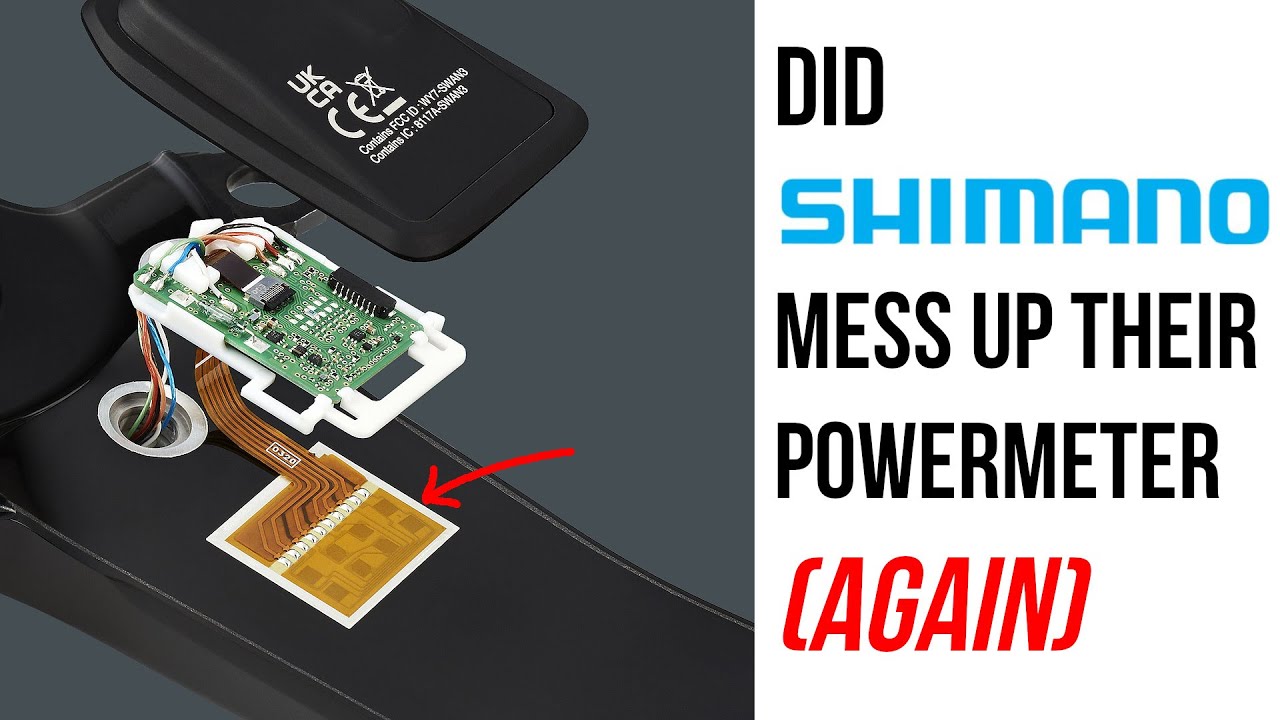
That was from a year ago.
Why do you need to account for the size of the chainring? The calibrated strain response, lever length, and speed make power. It’s a bathroom scale with rpm.
I know of a company that makes power meters using this principle using Shimano cranks for fucks sake. Physics is physics.
2 Likes
There’s something with the asymmetry of the spider on newer Shimano cranks that makes the right-hand power fluctuate. DCR and GPlama both went off on said manufacturer about it a few years ago.
I stopped following along, because they both use “accuracy” while comparing to other power meters. None of them are actually doing a calibrated test.
A non-linear stress-strain response would throw that off, it’s true, but I’m not sure that you couldn’t use statistics to mitigate that variance.
@amy might have more insight.
DQ what are you guys considering “resting” heart rate – the overnight value from a watch? I am asking because during the day I rarely see a heart rate of <60 when I am sitting at my desk, but my overnight “resting” heart rate is in the mid-40s.
1 Like
Your HR is 20 bpm lower while sleeping than while resting in the day time?
That is weird. At least if my watch is accurate, that is not true for me. My resting HR is around 60 most days and it’s usually in the low 60s while sleeping - but if i’m like laying on the couch lounging, it’ll also get into the low 60s. Maybe not below 60 (57-59 is about as low as i see on my HR graphs), but it’s pretty close.
I just go off whatever the watch calculates it as. I dont know what it means.
Speaking of which… I tried turning on sleep pulse ox tracking and it kept saying i had like 80% oxygen at night so I decided if I am going to die in my sleep I’d rather not know about it. (I dont think the readings were very reliable).
2 Likes
Yeah looking at my watch right now it’s at 62 sitting at my desk and last night it was 46. I would assume that is not weird since during the day you are upright, and of course there are all the daytime stressors that don’t exist while you are sleeping. Also obviously I’ve had a bunch of caffeine.
I am just curious what people consider their RHR
I use the Garmin 7 day average and realize how out of shape I am. RHR is ~66, at peak fitness in 2021, it was 51bpm for the year.
Edit: I don’t know how the hell people can wear a watch tight enough to get valid readings while sleeping. it drives me crazy.
1 Like
I loosen mine in the middle of the night on a regular basis. It seems like while at rest, my hands/wrists swell up a bit.
also i went ahead and googled this for you ferg, as it’s a i expected, RHR is your HR while resting awake, not your sleeping HR.
Based on the data that I’m seeing nighttime RHR simply represents the lower bound of your normal diurnal variation. Obviously far more accurate and reproducible than a daytime rate. Also I think I’ll go with that one because I like having a RHR of 45 
About 1 years ago when I was in the best peak fitness I was in the hospital all hooked up to machines and I was like “yo wife watch this” and I could lower my heart rate by 5-15 beats by relaxing and regulating breathing. I felt cool for a minute
Currently trying to do that on zwift while exercising
2 Likes
Thinking back to old HR-based training guides, they advised using RHR measured first thing in the morning (awake but before getting out of bed) as a metric for fatigue. I guess HRV has replaced that these days.
According to Garmin, my average nighttime RHR for the past year is 39 BPM. During the day, if I’m sitting it tends to be in the mid-40s to mid-50s. Standing at my desk it’s 55-60.
1 Like
I love hearing about how biathletes can do this as they transition between skiing and shooting. They’re dropping it by more like 40 bpm.
Yeah, it feels pretty cool to be able to control your body like that.
This is my primary form of entertainment on zwift. Got down to about 10-20 seconds to reach homeostasis at peak zwift fitness.
1 Like
Because I have been monitoring my blood pressure recently I spend a bit of ime looking at my HR too.
I do about 6 samples. Tonight, about 59, previous time, 54, previous 48, 52, 49, 49, 50. That’s averages of sets of 6 samples taken while relaxing on the couch watching TV.
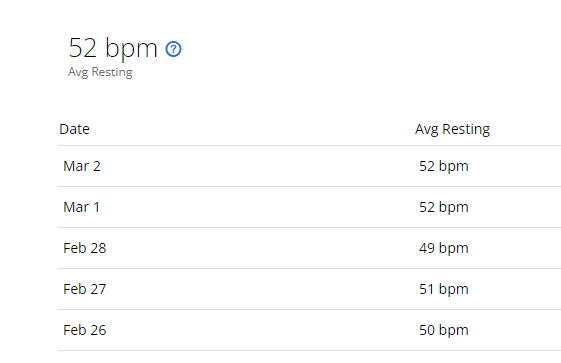
My idle HR during the day before I get wanged out of my mind on caffeine is ~55-65.
Definitely helps if it’s snug on your wrist. Here’s mine from last night. Not wearing my dental appliance for apnea lately until I get a permanent crown installed. The correlation between SpO2 drips and awakenings is pretty disturbing.
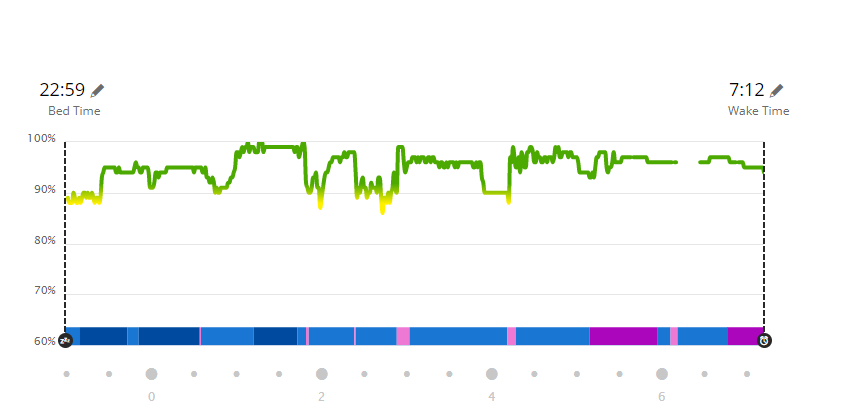
I should probably tape my mouth and see if that helps.
I started looking at my HR first thing in the morning and it is in the high 40s low 50s. Presumably the low 60s during the day is from caffeine and an occasional nicorette
1 Like
Heath have you looked at post-exercise heart rate recovery? I finally figured out how to do it on my Garmin and show it in Garmin connect using this bookmarklet
Garmin is so stupid sometimes, they should be showing 1- and 2-min heart rate recovery on a nice easily accessible graph
I keep hoping that the advent of a real Apple fitness watch will push Garmin to innovate and be more responsive but so far it seems like they consider the Apple fitness watches more of a toy than a tool and not really a competitor