If you made the moped all at once, you’d probably get regulated like a motor vehicle company. If you build it step by step and make it so that the moped can be arrived at by some consumers on some models, you’re still making a bicycle.
It’s the transportation equivalent of making a medical diagnostic tool vs. a diagnosis facilitation tool. The latter takes like a decade less long to get to market and has way less oversight.
13 Likes
extremely specific analogies are very tarck
13 Likes
Is this our answer to sram abandoning 2x exact actuation (1:1) danglers? or is it still gx with a pullamajig.
there is no longer the 2x10 GX variant?? It’s exact actuation
I think it has promise in TT/triathlon, but I’m mostly very skeptical.
They claim better drivetrain efficiency and more aerodynamic, especially if the aero/dust cover is in place. That has direct benefits for TT/Tri bikes and owners of those bikes might look past the other drawbacks.
Their various materials and video interviews say:
- Mechanically efficient,
- More aerodynamic,
- Cost less to produce,
- Less complicated,
- Can be enclosed (i.e. no more greasy chains)
- 3% better in the wind tunnel compared to a Dura-Ace equipped bike" (tested at Specialized on a Venge).
- Bearings are sealed
- Road, city, e-bike, mountain bike, all applications workable.
Investor pitch source of most claims
2019 interview and demo with MTB system and shifting demo
2018 intro video
Going through them I say:
- Mechanically efficient
I’m sure they’re not making up data, but I question how much this relies on perfect alignment of all the parts, a perfectly clean environment, and if this is with sealed or unsealed bearings.
- More aerodynamic,
Especially with the cool aero cover I have no trouble believing this, sure. But I also don’t believe that a D-A drivetrain is the pinnacle of what Shimano could achieve if they wanted to make a more aero dangler.
- Cost less to produce,
They claim this without evidence. From where I sit it seems like you need a proprietary frame held to very good alignment, a cog set that needs to be milled or otherwise made in a more expensive method than coining. but maybe the fewer parts argument helps.
- Less complicated,
I guess when you consider all of the individual parts and linkages and such that make up a typical rear derailleur, this might arguably be less complicated, but I’m not sure it’s less complicated in a way that actually makes a difference.
- Can be enclosed (i.e. no more greasy chains)
Sure, but you can enclose a derailleur drivetrain too if you really want to.
- 3% better in the wind tunnel compared to a Dura-Ace equipped bike" (tested at Specialized on a Venge).
This is one of the strongest arguments for the system and if it holds up along with efficiency claims, and other issues can mostly be addressed I could definitely see top end TT and triathlon bikes using this system.
- Bearings are sealed
The videos and stills I looked at all showed unsealed bearings. I want to know if their efficiency claims were produced with unsealed or sealed bearings.
- Road, city, e-bike, mountain bike, all applications workable.
In theory sure why not.
Overall I am skeptical that this system relies on a proprietary frame design and just how good do the assembly tolerances need to be to actually realize the efficiency gains? I am very curious how it would hold up in bad weather or gravel riding, though the nice aero/debris cover is a good solution. Current systems are very tolerant of misalignment and chainstay growth like on full-sus MTBs.
It has a huge drawback in terms of tire clearance near the chainring especially for MTB applications. The cassette and chainring will be expensive to produce. Right now it’s wireless only which is fine. Seems like they could work to reduce wheel dish a bit, but at some point heel clearance to the driveshaft is an issue.
They never once mention WEIGHT which is a suspicious omission.
10 Likes
wondering what an aero chain cover or some profiling to a dangler would be. also- 3% better… what? g of drag of a static bike with no rider? wondering how many W that translates to or what the impact is on the entire system of a bike being pedalled by an actual human
1 Like
There is a roller-pinion + rack gear or round gear system that rom about 2016 they say it’s patented and is 99% efficient. But most of the online materials are focused on it’s zero backlash over long distances and therefore use in linear actuators like on big milling machines or whatever.
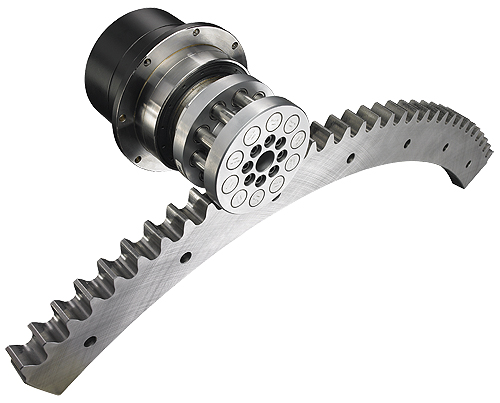
If it’s really 3% more efficient that is huge and I was wondering if there were any examples from motorsports. I’m guessing high speeds and heat may make it not good for those applications but who knows.
2 Likes
it is for now. but sram has long since declared 2x dead for mtb, so i’ts only a matter of time
1 Like
It’s unclear what that 3% benefit in wind drag entails - is that 3% over the total drag from the bike or 3% from just the drag attributable to the dangler or 3% of total drag with a rider. 3% of just the bike’s drag (including spinning wheels and cranks) at 250 watts output is less than a watt saved…
6 Likes
@Banjo it’s fun watching someone who apparently hasn’t been steeping in bullshit bike industry marketing claims for the last few decades approach this stuff affresh.
It’s just 3%, which is both a quantity, sure, but also a conceptual quality that you can associate with concepts like “marginal gains” and “effciency” which are all relevant to the whole fast bike thing, and it doesn’t really matter whether or not it has much of an actual impact on your riding.
5 Likes
That’s certainly true. I suppose a lot of the marginal gains things don’t come with tradeoffs - making the tubes aero shaped doesn’t really have a downside on a gofastbike. But totally overhauling part of the bike that makes it go is bound to have some kind of tradeoff that may or may not be worth a few seconds over a century.
3 Likes
aero tubes are typically heavier and less comfortable
1 Like
100% read this as aero lubes
3 Likes
i would imagine those are lighter and less comfortable
5 Likes

The drivetrain concept also seems to rely on/require an elevated-stay frame design, which are relatively notorious for being wiggly… I look at this and I wonder how that’s gonna impact whatever careful alignment is required to make the drivetrain work right. Once real nice thing about chain drives is that they don’t give a shit about the frame twisting and flexing (to a certain extent).
1 Like
I’m glad to see Tarck deconstruct this bullshit so that I don’t have to.
2 Likes
The extra watts put into the drive train cause a lot more wear, which means folks blow by typical maintenance internals without realizing if their bike doesn’t have a ebike specific drive train that is beefed up for the application.
1 Like
new and intresting machine learning
edit: all of this ebike/information technology coming from Shimano is making me want to hoard a few current mechanical Ultegra groups against the day when you can only buy super intrusive electronic shifters.
3 Likes
Electronic shifters ain’t really intrusive. Quite the opposite.
As for this ML stuff, well. It’s everywhere. Probably best not to think of it as “AI” and more of a means by which an optimized algorithm can be created by a device.
You could, for example, create a PID loop and spend endless amounts of time tuning it for the broadest set of riders, of implement a few tens of dollars worth of microprocessor and ancillary components to sort this stuff out on the fly.
what does ML mean