No!
He got sued when one broke and now he’s hardcore about underpromising and cinch strap backup.
Or so I’ve heard. All the dudes out here are so burned out that it’s had to tell what happened and what is just lore.
Nitto M12s reliably snap where the crown bolt is brazed into the extension tube or at the thread root, I’ve seen 10-20 failures myself and it doesn’t require load at all to break
Here’s some examples: https://www.flickr.com/photos/jimg/sets/72157629251877640
The more expensive Nitto M13 is much better
Best is a design like the Rawland racks with a tab and independent bolt in double-shear, or my Cyclefab design with female threads in the rack that orients the bolt in the right direction.
With the immediate pop up asking for your email, I say they deserve it.
oshi…
I’d heard of these failures but never realy thought about it
TL;DR embrittlement (or embitterment as auto correct would have it) is why we can’t have nice things
Given the “no load to cause failure” and those photos (esp fracture faces) looks like teh manufacturer decide to braze and then chrome plate some fasteners. Which, if those fasteners were high grade carbon steel (definitely 12.9, maybe even 10.9) is a recipe for disaster.
Firstly brazing could get the bolt into the “temper embrittlement range” which would not necessarily make it any weaker, just less ductile, it’d still take a bit of force to break.
Note that this would affect the whole thickness of the bolt.
However, chrome plating is probably the real killer, high strength steels suffer from hydrogen embrittlement.
12.9 bolts can die of it in just plain humid environments (ask me how i know), let alone electroplating, where actual gaseous hydrogen is evolved at the metal surface in quantity.
In electroplating only the surface pf the bolt would be embrittled. However, given the possibly rolled threads, hydrogen embrittlement may cause cracking immediately, due to residual stress. When combined with temper embrittlement this could lead to anything from spontaneous failure during or shortly after installation to initiation of fatigue cracking followed by an untimely death.
5 Likes
Tarck Consulting LLC invoice terms are thirty days or 30 days, whichever is the lesser.
4 Likes
you know it 
P.S.
here’s an electron microgrpah i prepared earlier
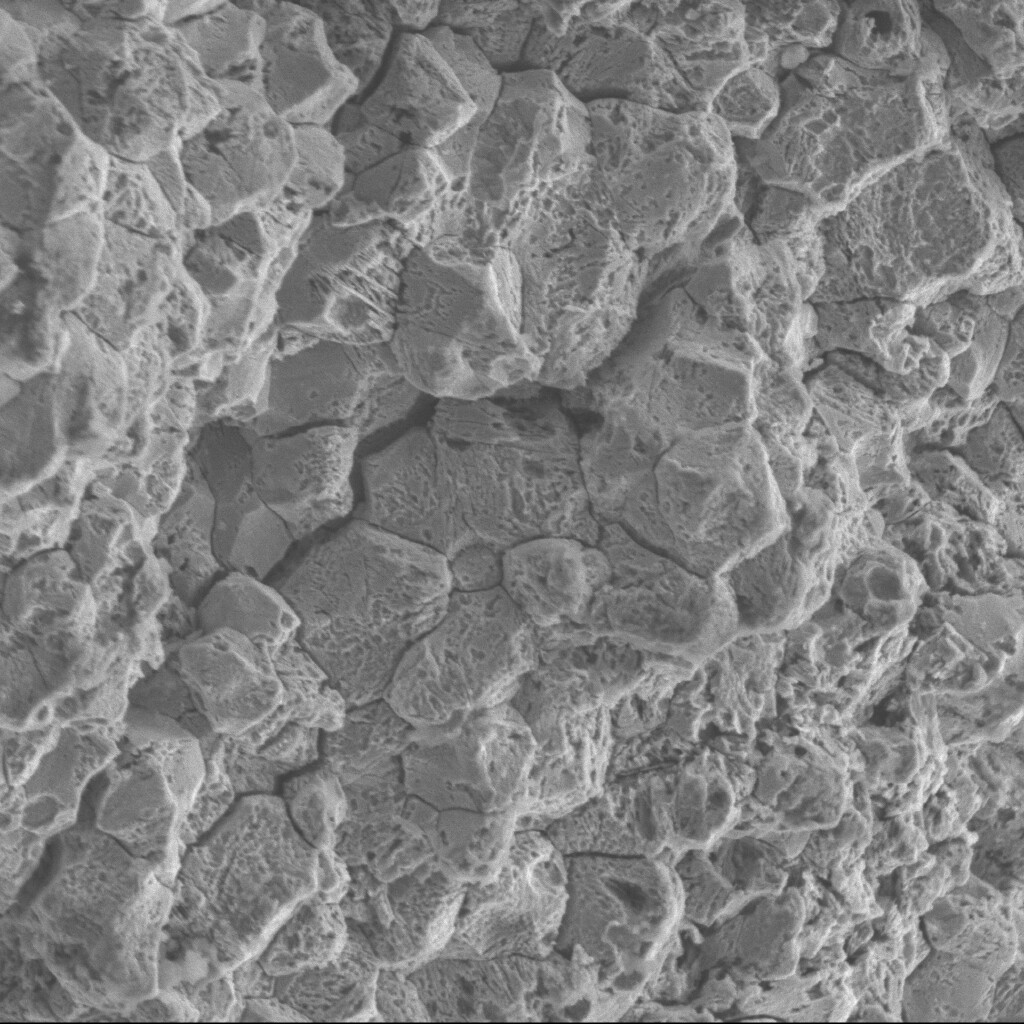
basically hydrogen migrates to the grain boundaries and the metal almost literally “falls apart at the seams”. in this case it was a 12.9 bolt under preload, and the boundaries were just weakened, resulting in intergranular fracture under the applied load, but in extreme cases the hydrogen can actually achieve such pressure within the metal that it causes blistering
PPS fracture face is also corroded, a fresh HE fracture can have perfectly smooth crystalline facets
3 Likes
Fukn love having sci-Tarck on the scene
1 Like
Who knows Nitto’s engineering rep?
1 Like
So if you just used a regular nice bolt and did not plate it, you’d be fine?
yep, or better yet a stainless bolt (cos stainless) and doesn’t suffer from the temper ebrittlment like a high grade steel might.
Note that if you’re brazing a 10.9/12.9 with brass (red heat) it won’t be a whatever it started out as by the time your done anyway cos it will effectively be annealed at those temperatures.
Stainless doesn’t brittle when tempered? That makes me want to get one of those stainless tubesets for bikes now and play with it.
Those stainless tubesets cracked for some other reason. My metallurgist pal runs a lab at Carpenter Technologies, and they saw a bunch of the seamed tubing come back for failure analysis.
In the interests of brevity, partly cos not getting paid, and sometimes cos on phone, I haven’t given all the information [citation needed]. TL;DR, there’s a reason degrees are 4 years and ASM handbooks are thicc
So when I said stainless doesn’t embrittle, I was referring to 300 series, typically used in readily available bike sized fasteners (marked A2 or A4 - something on the head, fun fact: that something is the tensile strength of the bolt in 10s of MPA (i.e. 70 = 700MPa) yield strength in KSI, a weird freedom unit). 300 series is austenitic, single phase austenite, consequently heating and cooling in a brazing context don’t do anything significant to the microstructure and hence mechanical properties (which is not to say long term heating can’t be bad).
Stainless tube sets are a different kettle of worms, they are martensitic, same microstructure as high strength carbon steels, and incredibly complex proprietary alloys (except KVA, which is glorified 420{blaze it} and seam welded). 420 can theoretically surfer from stress corrosion cracking, which looks like brittle fracture, the big name SS tubes, i have little experience with that kinda metallurgy.
Chatting with local PI Frame builder at cross race once, he was of the opinion that it wasn’t worth the hassle. put the effort into corrosion protection on “normal” steel.
PS if you’ve read this far he’s your prize: A2 =304 (18-8) and A4=316 (18-10) the notionally “marine” grade, cos moly for pitting resistance
Edited cos wrong, and moar galling, my worngness removed my grounds for bashing freedom units
3 Likes
Aka sweet paintwork. SS frames and racks have always seemed to offer no real benefit to me over CS but a lot of downsides
I love this thread 100% more right now. BRING ON THE MATERIALS SCIENCE.
1 Like
JFC I hate dentistforums so much
Hell yeah!

IDGI