Here’s the book you’re referencing:
http://caravan.hobby.ru/materiel/Bicycle_Wheel_-_Jobst_Brandt.pdf
Here’s the book you’re referencing:
http://caravan.hobby.ru/materiel/Bicycle_Wheel_-_Jobst_Brandt.pdf
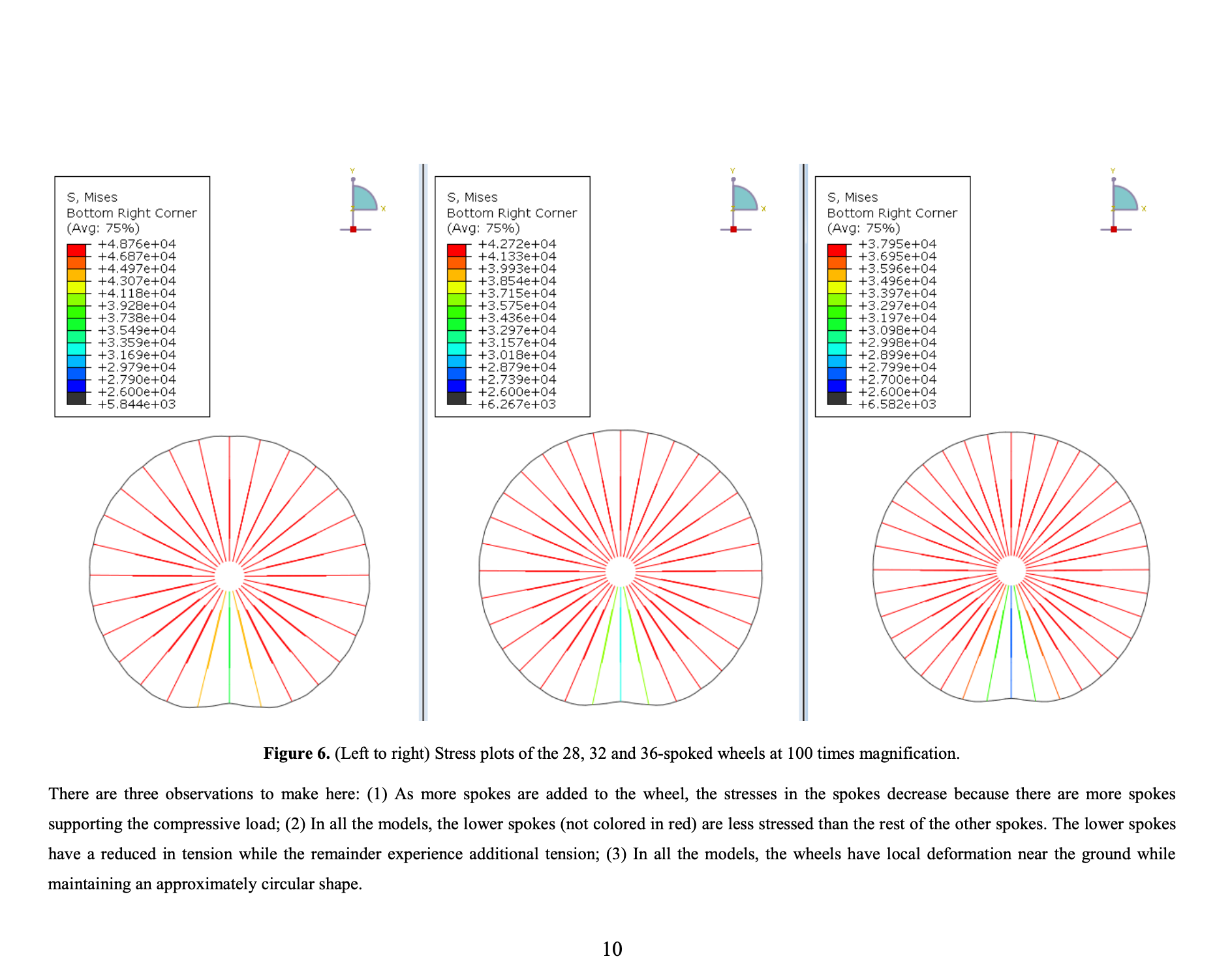
Compressive forces are borne by the structure becoming less tense.
Same as how tensile forces in pre-stressed concrete are borne by it becoming less compressed.
yes but we’re talking about the spoke and hole interaction, which is always tensile (unless you smang something hard enough to make the spoke go slack).
there’s a good joke about pretention and pre-tension in here somewhere
Generally, when a topic piques my interest, I read all the things available to me and apply my own reasoning. Whatever that reasoning may be, I’m happy to explain or defend it.
In short, what’s your point. Don’t you read things?
Okay, yes. I think I mentioned “compressive forces”, which I believe is fairly accurate. The forces are compressive and are borne by the spokes becoming less tense.
I believe what most folks commonly think is that the spokes above the axle go into great tension, in a sense the axle is “hung” from the rim.
Tangential forces applied to the hub, either braking or driving, are transmitted through the spokes both via compression and tension.
You got me. That is incorrect.
After many years of tarcking I am under the impression you have a tendency to take the things you read as some kind of gospel
And then impose that information on people with more practice and deeper, although often more nuanced and, as such, less resolute opinions
I can understand why you have this impression of me. I generally argue my opinions with a great deal of confidence the goal of which isn’t necessarily to convince anyone that I’m right, but rather to be proven wrong. Being wrong is awesome, that means I have access to some new information I didn’t have previously.
Also, I think you’re making some assumptions about me as a person, my experiences, etc that may not hold up if you knew me in person.
I think arguing your opinions with such confidence
I would be very happy to meet you in person. Next time I’m in SF. Until then the only way I will know you is how you present yourself through the internet.
I’m not really any different in person than I present myself through the Internet, but of course, you shouldn’t believe me when I say that because how the fuck should I know?
Come to SF, drinks are on me.
While this might be semantically or mathematically true, it’s not true in a meaningful physical way–the spoke isn’t actually loaded in compression; it’s simply relieved of some of the tensile force. It’s an interesting fact that the bottom spokes see reduced tension, rather than the top spokes seeing increased tension, but they’re all still tensile elements.
Wholly agreed.
Now we’re onto semantics, which I would suggest is important to have a complete understanding of what’s happening. There is a compressive load from the axle through the spokes which the spokes bear with decreased tension. The spokes themselves should never be in compression. They would buckle immediately.
The real distinction that I was attempting to make was the fact that there is no (really very little) tensile load from the axle to the spokes above the axle.
My motivation in point all this out isn’t to be pedantic but to point out a phenomena that I think is really interesting.
TL;DR: heads out radial lacing SUCKS
Why?
we’ve moved beyond the 19th century
That’s not reasoning, that’s hyperbole.
If you have looked at a calendar lately, it certainly isn’t hyperbole.