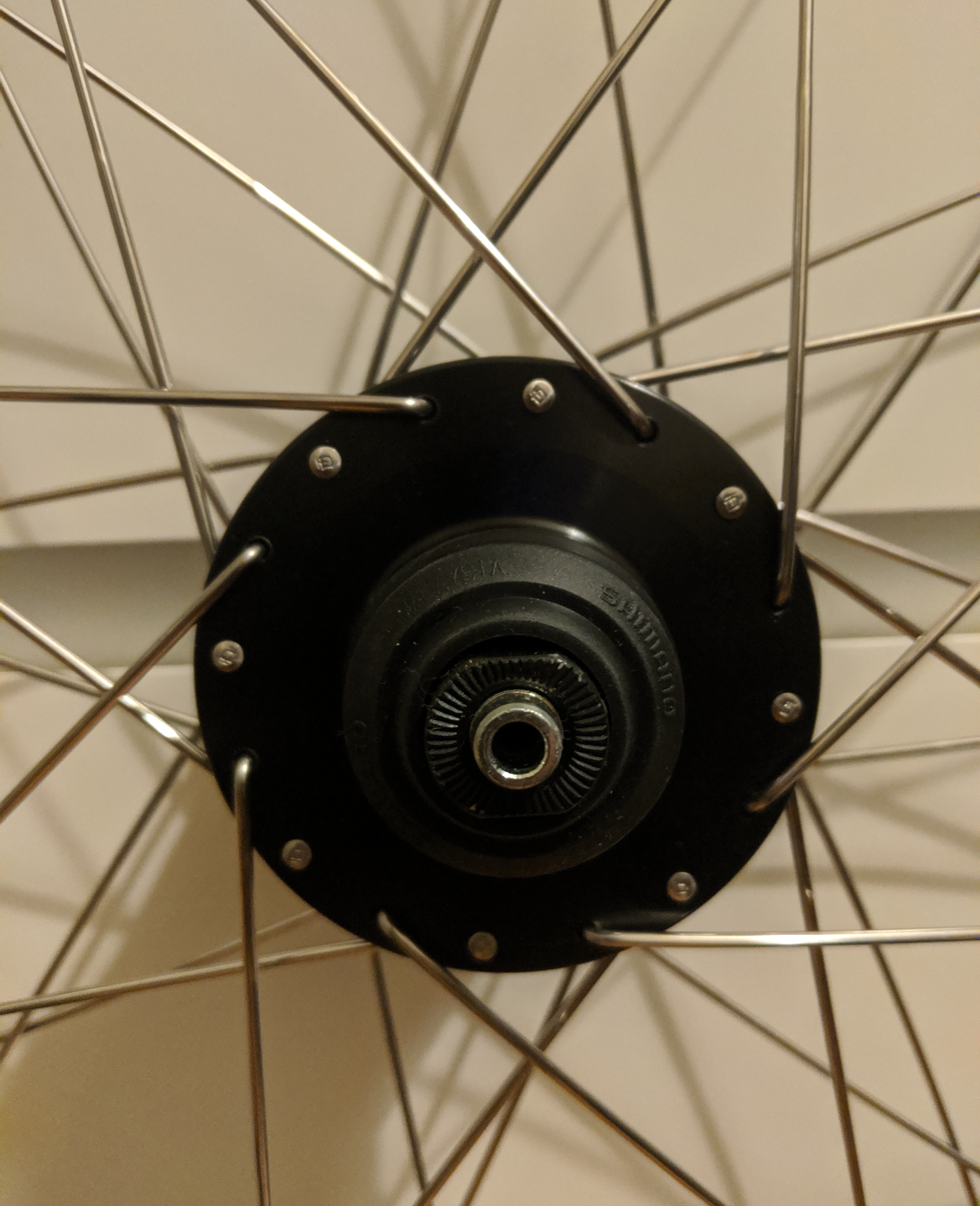
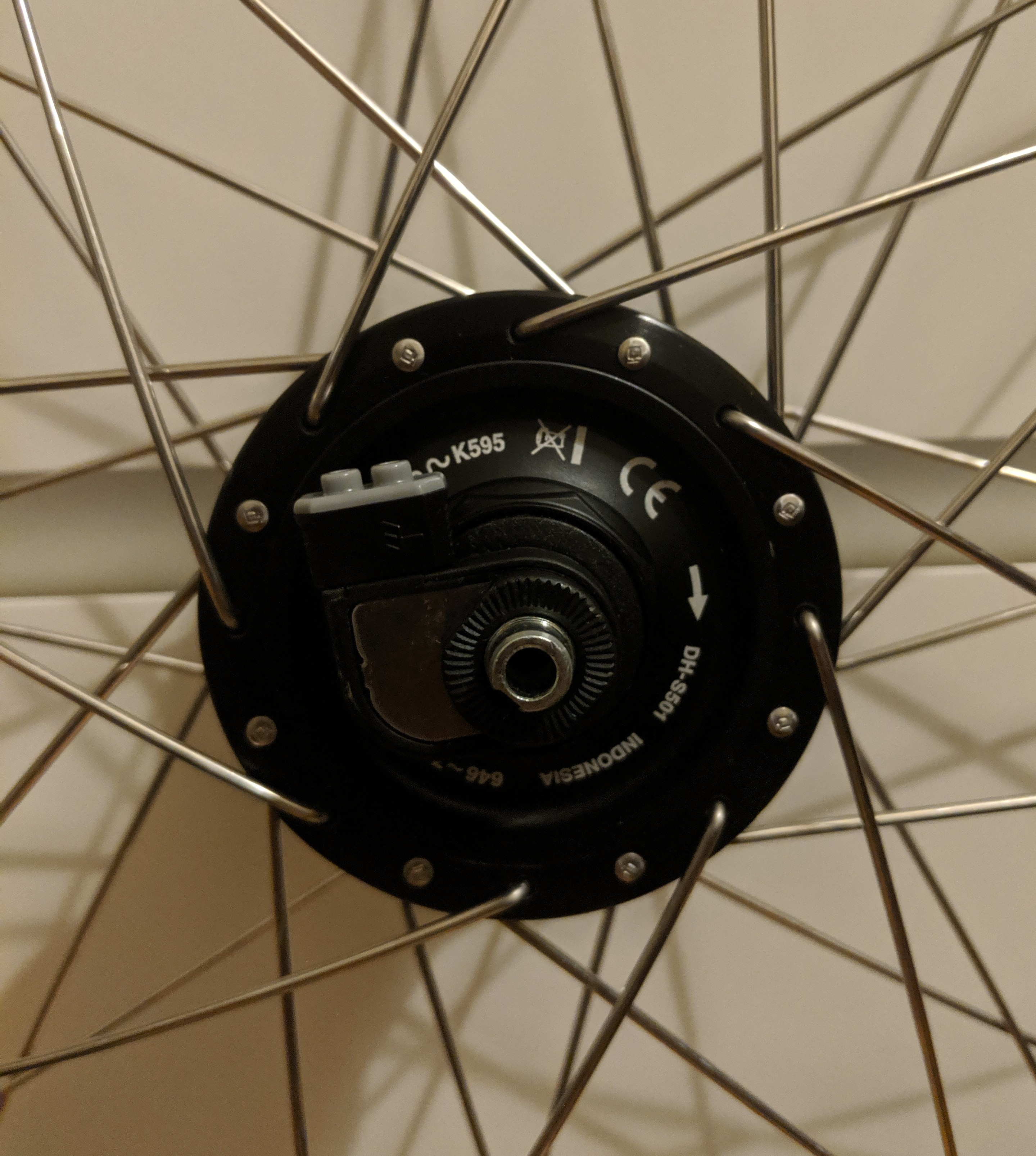
Is there a wheelbuilding thread yet?

Passed a basketbiek onto a friend with a 650B 28H synergy / Ultegra rear wheel (after replacing the cracked aerohead previously) and lo and behold the synergy has cracked too. :wastebasket:

Are there any 28H rim brake 650B options that aren’t a HED Belgium+ and can be had on prison island? I’ve given up looking for non :money_with_wings: unicorm rims and the deadstock pacentis are gone too.

I suggested I lace in the remaining aerohead temporarily while he finds a 32H road hub and get a VO Voyager, but then this weekend I found a pair of vintage 36H Araya 650B rims laced to junk steel hubs as well as a shimano parallax 36H laced to an ano Mavic 26". Just need to add spokes and he’ll be rolling again.

blessed :tarckbear:, who provided me with rims at the tip shop in my hour of need.

4 Likes

Tarck,

I followed a video my friend let me borrow to lace up a 32/3x dyno disc wheel. It was an older video (meant for rim brake wheels) but there was some updated text on screen over the vocals about changes need for disc brakes. Kind of tough to follow, but got it laced (TC ok after 2 tries…but I’m not counting the first try because kids were helping me).

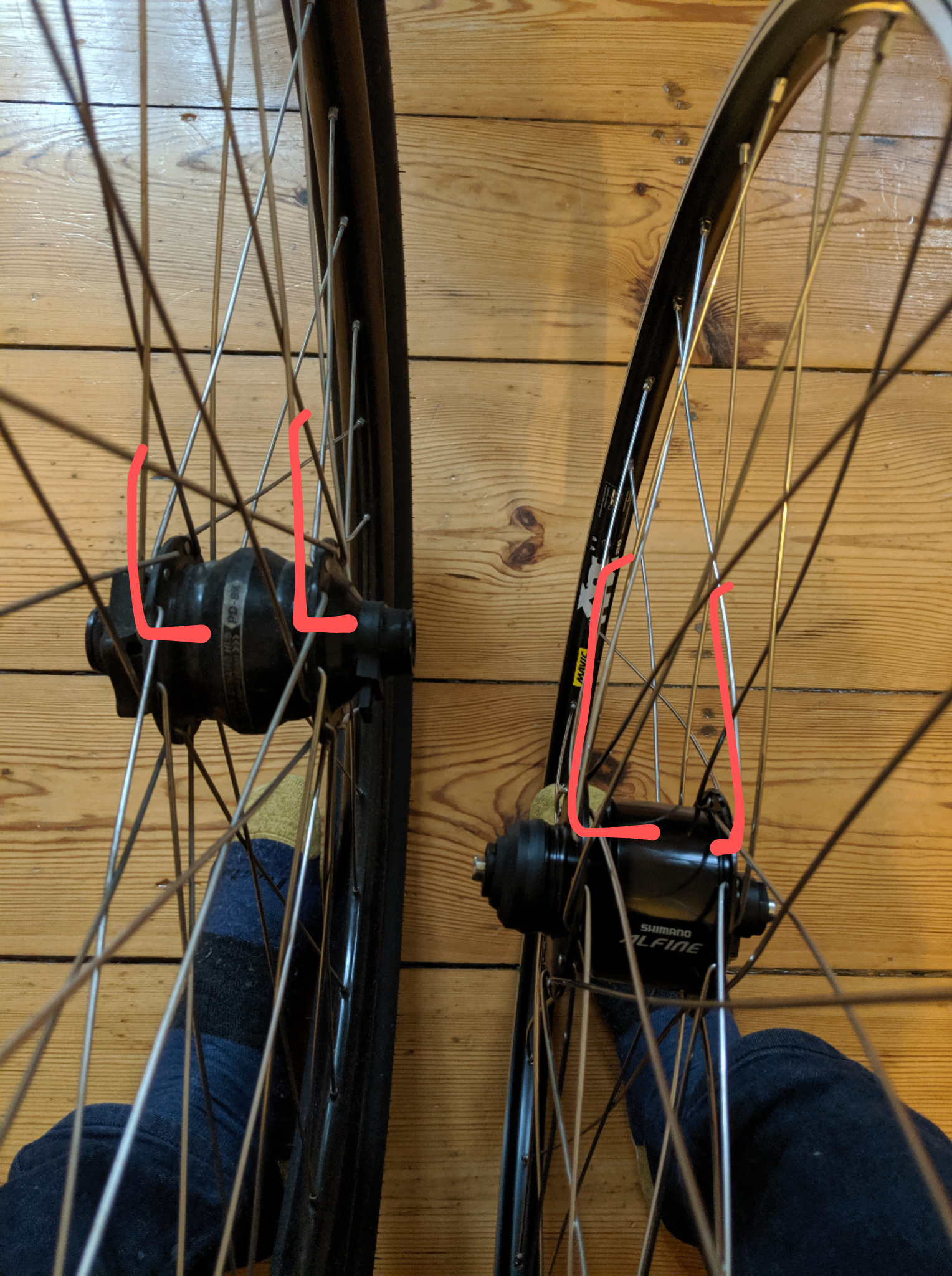
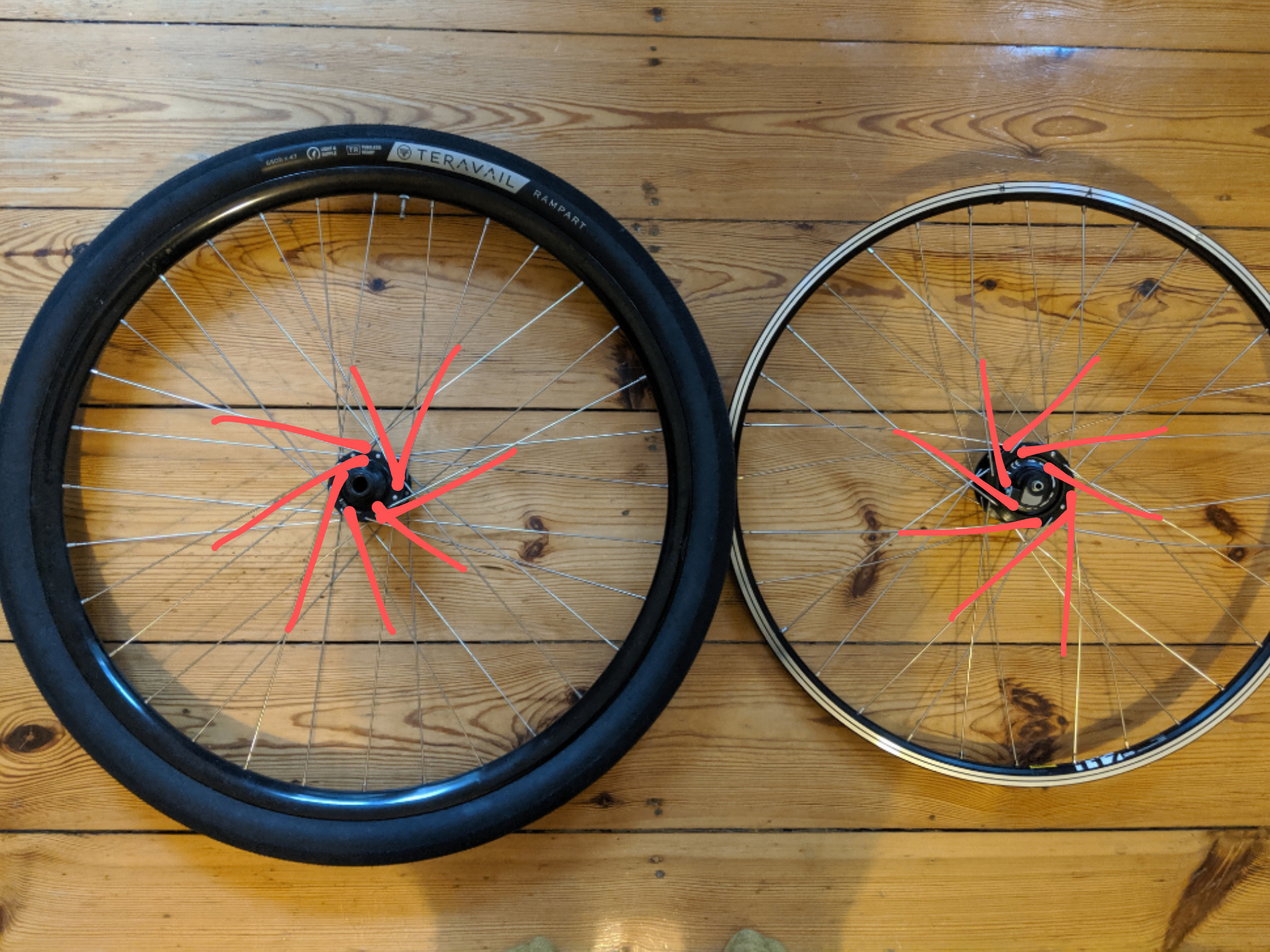
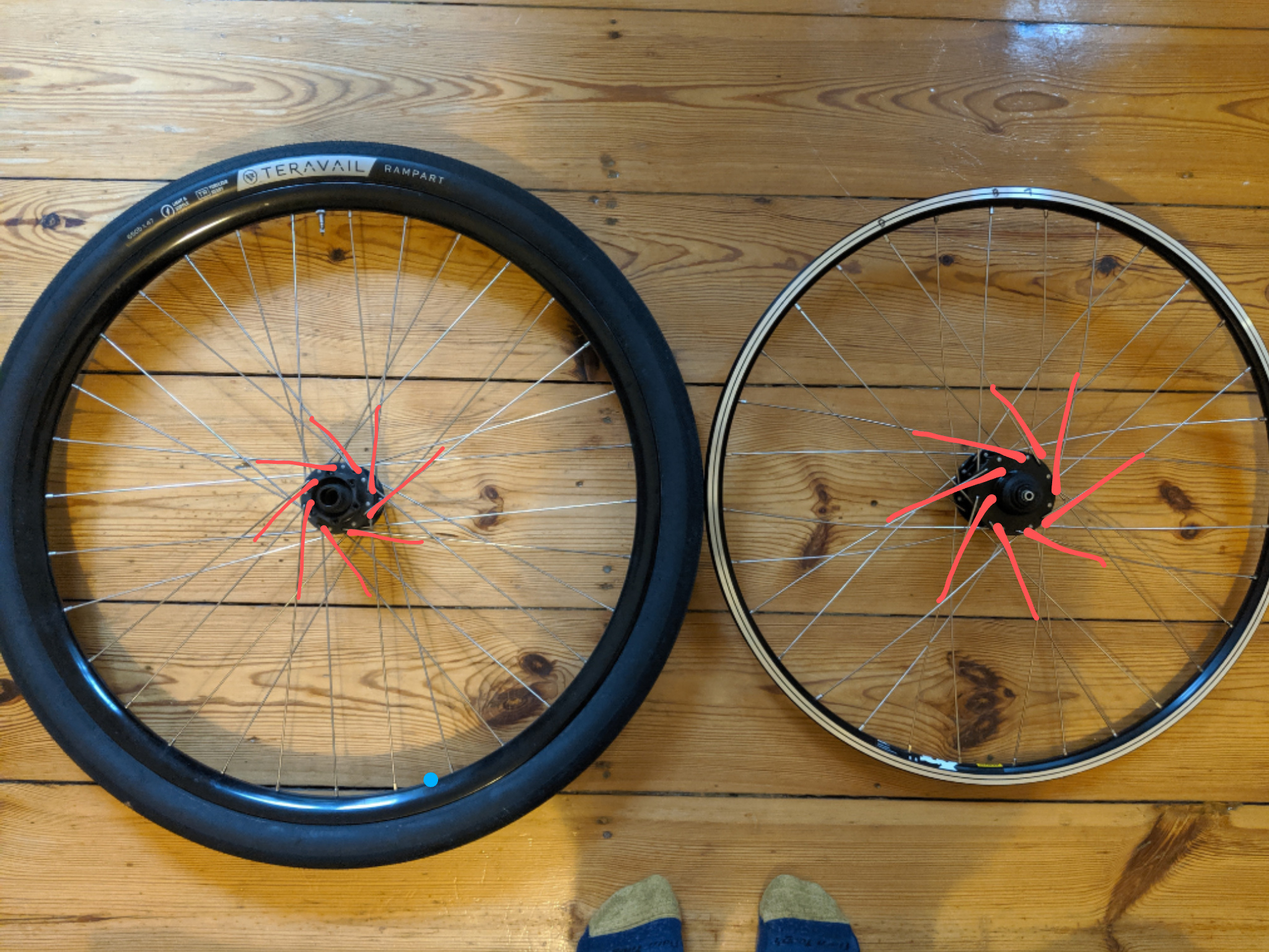
At first glance the lacing pattern seems correct, but when compared to another dyno disc wheel I realized the drive side spokes are inverted.

Is this wrong?

I’ve wonderd (and asked) about this in past, and the consensus seems to be that from an engineering standpoint, the change in orientation is good for managing the forces exerted on the hub and spokes by the braking setup, but also that lots of people use whatever lacing and don’t die.

Also you …borrowed a video?

I read a bit about that PVD vs. Shimano vs. whoever else disc brake lacing debate, and honestly was a bit confused. But I thought it was only discussing the NDS spokes. I seemed to have laced the DS different than a “professionally built” wheel I have here (both disc). But sounds like YOLO?

Also, in this case I did in fact borrow a DVD :slight_smile:

If memory serves, PvD says lace the nds for disc like you would lace the ds rear, rather than lacing mirror images.

If this is going on a bike you’re riding around town and has a 140-160mm rotor, and you’re not living on the edge of the Grand Canyon, it’s probably ok. If you’re building a wheel that will take a 203mm rotor that you’re going to be doing abrupt stoppies on, I’d take the time to sort it out.

Spoke orientation is a difficult thing to conceive. The spokes themselves are tensioned sufficiently to take force in compression. The force components are radial, lateral, and tangential.

The radial force component is the wheels ability to carry the load. It’s transmitted from the frame and fork, through the axle down through the tensioned spokes to the ground. There is some force in tension, but not very much. (this is a brain bender)

The lateral forces are side to side forces that come from turns, springing, leaning the bike over somewhat, etc.

The tangential forces are from the driven components, the cogs, as well as rim brakes and disk brakes.

Tangential forces applied to the hub, either braking or driving, are transmitted through the spokes both via compression and tension. The greater the number in the cross pattern, the more leverage the spokes have against these tangential forces. This is why it’s recommended to use a 3x pattern on driven and disc wheels.

The problem with the cross pattern is that spokes in that orientation lose leverage against the lateral forces acting on a wheel. The most optimal orientation of spokes against lateral forces is a radial pattern with the heads in. This is why rim braked front wheels are typically laced with a radial pattern.

There’s some argument that heads out is more aerodynamic, but I believe that’s poppycock. It’s all a big mess of turbulent air in any case.

I would say these are the fundamental requirements driving the design of a lacing pattern. From everything that I’ve read on this topic over the decades, the only concern with heads in vs. heads for a crossed lacing pattern is whether or not the base of the spoke becomes deformed, which will weaken it somewhat.

That said, I’d be interested in reading PVD’s take on the subject. He tends to be a pretty sharp cookie.

https://www.peterverdone.com/archive/bikewheels.htm

I think one challenge with wheelbuilding advice, as our respective posts demonstrate, is that there’s either loose empirical rule of thumb or a long consideration of forms and forces. It makes for tricky reading!

The margin of safety for most wheel building situations is so large that a ham-fisted home machanic can generally just follow a rule of thumb and won’t have any problem for years, even if it’s “wrong”.

2 Likes

that’s 100% what I’m counting on

the dyno front I built for my cycletruck is too small to fit my spoke tension meter, so I got the spokes to what feels like a good tension, and I’ll just stress relieve and true it a couple of times until it calms down.
Bonus for the home wheelbuilding bozo: the age of discs is making it really easy to ignore a 1-5mm wobble for months at a time

A heads-in spoke “beds in”, giving a larger area of support and lower localized stress. A heads-out spoke has less support with all stresses being carried by the head area.

True.

I wanted to add that the relative benefits of spoke orientation have more to do with yielding even spoke tension and a wheel that’s more durable with a longer lifespan that tends to stay true for longer. Having the wrong spoke orientation is unlikely to lead to a sudden failure.

Beyond that, “feel” is somewhat important. As a man of substance, I’ve come to the conclusion that I really like 14ga double-butted spokes. I’ve tried lighter, but I end up with a wheel that’s too whippy for me. I like radially laced front wheels. I also prefer 32/32 or 28/32.

Some of the spelling mistakes are hard to bear, but whatever. There’s some good info there.

Breaking forces are tenfold driving forces.

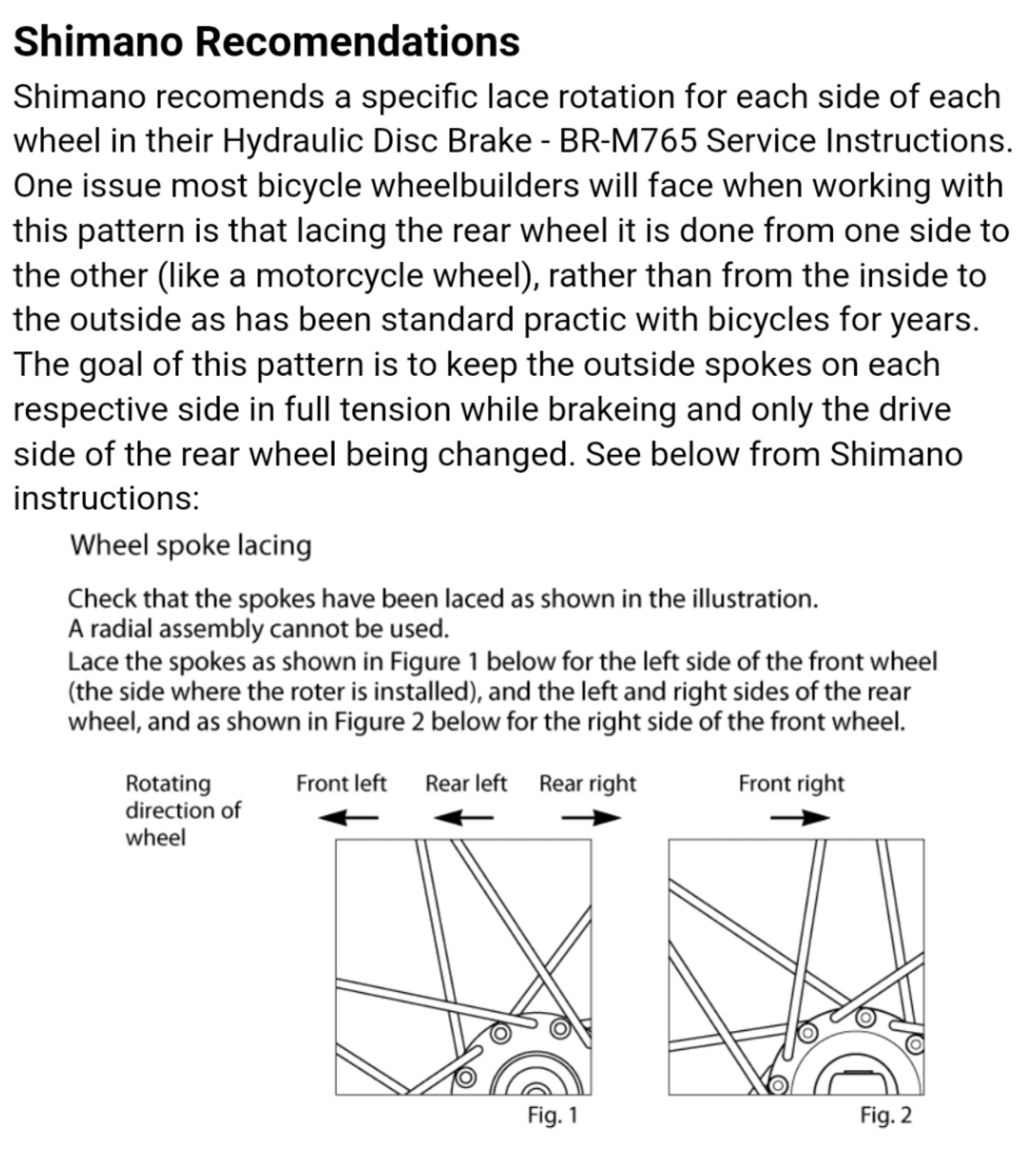
The Shimano pattern does specify that the outside spokes are tensioned and the inside spokes are compressed under breaking.

I have no doubt that this is the optimal orientation for dealing with braking forces.

Slowly making my way through the links and comments, but looks like the wheel I laced today does comply with Shimano guidelines (above) but the other wheel I have does not.

Front Left

Front Right

This is a basket bike wheel, so I’m not worried, just trying to understand.

Thanks all

Ugh not this again

hey
heath read a thing watched a youtube video about wheelbuilding once
don’t you doubt him

1 Like

I’m not sure I know what you mean?

A bicycle wheel is like any other pre-tensioned structure. Similar to pre-tensioned concrete, only the exact opposite.

It’s easy to experimentally verify this. Take a bike. Measure the spoke tension. Put a person on the bike, measure the spoke tension.

Pretty sure that Jobst Brandt went into this extensively in his book “The Bicycle Wheel”.

He says it is compressed (and becomes slacker), not that it transmits compression.

Page 8:

" As in a wooden-spoked wheel, the bottom spokes of a wire wheel become shorter under load, but instead of gaining in compression, they lose tension."

2 Likes

Here’s some things:

https://www.astounding.org.uk/ian/wheel/