I use Rock n Roll nipple cream. Mostly because it has a funny name. It works better than the plain old Phil grease that I used to use.
2 Likes
One little tub of Wheelsmith spoke prep should last you a lifetime.
Jart’s grease is already a lifetime supply, better add another lifetime lube to the garage!
2 Likes
Was gonna say, I just ordered another lifetime supply of grease and it sounds like I can get away with using that lol
Loctite 220 is what I was taught and has worked well for me and all my builds. Low strength, low viscosity, wicking; works akin to a liquid version of Vibratite VC-3 in my experience.
Also comes in small bottles that will last a lifetime!
1 Like
Working on baby’s first rim swap in the garage when I look over at my LHT 
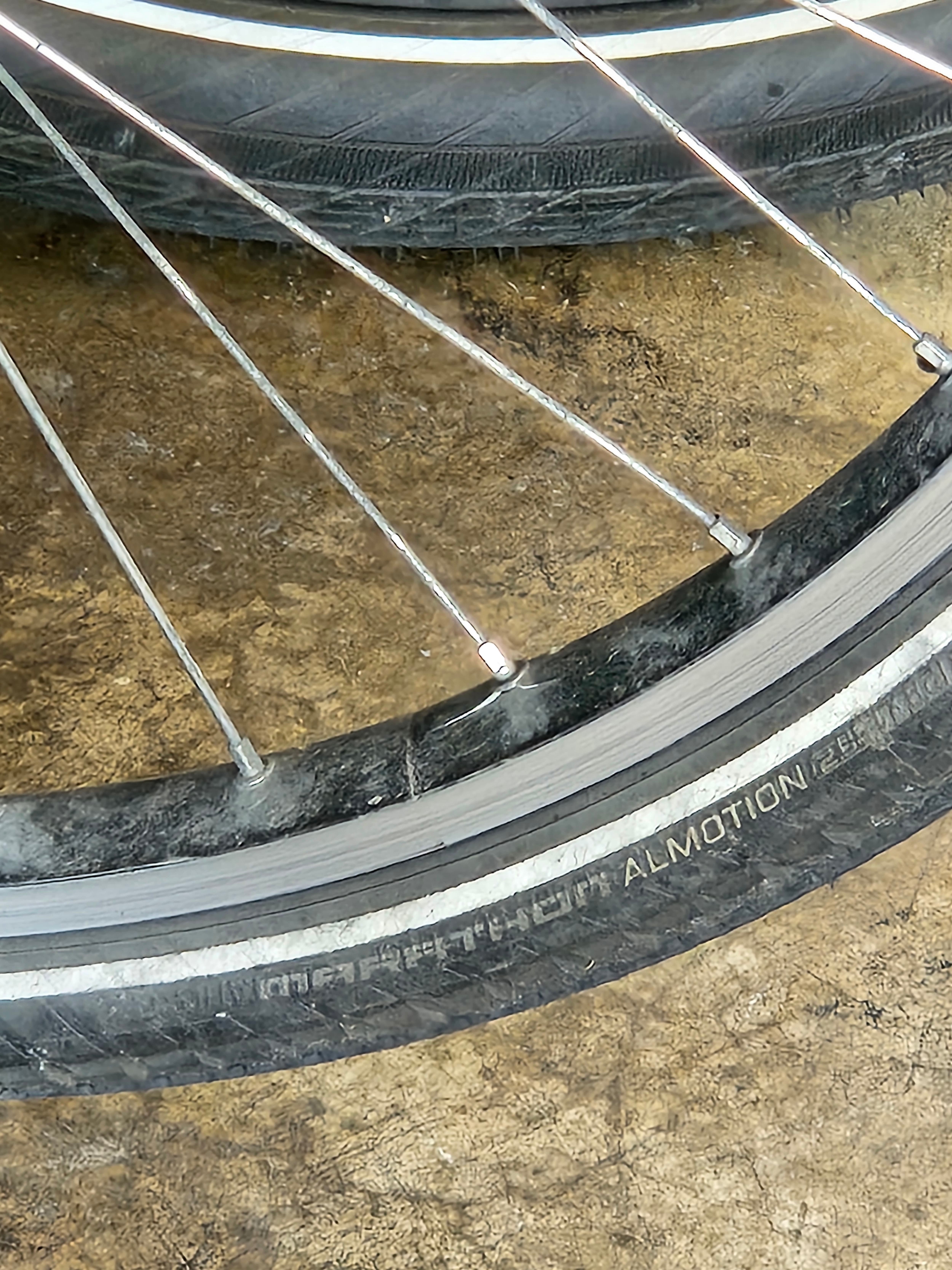
Jobst please look over me as I navigate this
13 Likes
The universe has decided that you need to learn wheel building.
5 Likes
I had a little existential crisis when Universal didn’t have the wheel or rim I wanted and j thought I needed a new bike. Then ModernBike had the rim and yes I need to figure out this wheelbuilding thing
2 Likes
You got this, bud.
1 Like
Just tape those two rims together and move the spokes right over. It’s like screwing 32 nuts onto 32 really long skinny bolts.
7 Likes
So I have got that far at this point. My lateral true is pretty good, tensions look pretty consistent on my Amazon tensiometer. There does seem to be a radial hop I need to correct but it’s been a long weekend so I am going to bed!
I think my biggest SQ about wheelbuilding would have been “how do you know if you have enough tension?” and it seems kinda like that mostly takes care of itself at a gudntite level if the spoke lengths are correct.
2 Likes
You’re not wrong
it can be satisfying to get it perfect but it’s okay to just go for close enough
also dont get it perfect right away because you’ll need to retrue after you load it
haven’t busted any (5) wheels i’ve rebuilt yet 
3 Likes
I’ve built 6 wheel sets and I still don’t have that figured out. How tight is tight enough?
1 Like
The reason I always build my own is when I have had other people do it they never make them stiff enough. I like to push it and have never really had a problem because of it
Look up the rim specs if they exist. Use specs from a similar rim if you can’t find them for yours.
Also, get rid of hop FIRST and keep it round while increasing tension. It’s so much more difficult to remove hop and maintain even tension once the tension is brought up in the wheel as a whole.
5 Likes
How so? This is the opposite of what I was taught. A wheel which looks true when untensioned has little chance of holding that appearance once it’s brought up.
I think it would help to share my whole process.
I start by attaching all the spikes and nipples by 2 turns. Everything is all floppy and wild and hardly held together in the shape of a wheel.
I start working only on the high tension side to turn them all in a few turns at a time until things are vaguely wheel shaped. Right as things start to come together and the rim is no longer flopping but before I could get a tension measurement I begin to take out the hop. From here I alternate checking for even tension and hop until I’m at a minimum even spike tension and by now there is zero hop unless it’s a funky aluminum rim seam.
Depending on the final spike tension and offset I get to 50/70% final tension on the high tension side before I start to touch the low tension side.
Starting on the low tension side I bring everything in a few turns at a time until I’m at an even minimum spoke tension. Then I alternate between checking even tension, lateral true, and dish working only on the low tension side as long as I can. If it’s a rim I’ve done before, getting into dish and final spike tension on the high tension side is like this:  with minimal inputs to the high tension side. If it’s a new rim I’ll start at 50% tension and then it will need some small adjustments on both sides, going through evenly a few times.
When checking tension on the low tension side I’m only checking for even tension. When checking on the high tension side I check for even tension and a specific target. I rarely need to work on any hop after the first step unless it’s a funky aluminum rim.
I guess it’s different if I’m doing a non dished or rim brake front wheel but it kinda just falls together if you add tension evenly. That shits rare.
After all this you gotta bed in and unwind the spikes and touch up the true a little bit. This is the process I used when building internal nipple carpet fiber hoops and going back to touch it up after a test ride ain’t an option.
1 Like
That’s pretty similar to how Easton builds wheels—tension up the DS then pull the wheel into dish and target DS tension with the NDS.
When I was building 10-20 wheels a day, the prescribed process was to get the wheel up to tension and rough dish ASAP before worrying about trueness. Only after two cycles of tension → stress relief would we start adjusting for lateral and radial true. Stress relief would introduce new tension imbalances, so it didn’t make a difference if the wheel was true or not beforehand. I never experienced an issue where a wheel at it’s target tension was difficult to true either radially or laterally…that usually indicates an issue with the runout of the rim itself.
2 Likes
I should clarify, the only difficult part is physically turning the nipples on some wheels without damaging them. I’ve had a few nipples round off or break when adding tension on the high tension side and just replacing the nipple ain’t gonna fix it. It’s also nice to not scratch up anodized alloy nips.