Have you ridden a proper Italian cotton casing, though?
If Veloflex made high volume TLR tires, they could drink RH’s milkshake.
Have you ridden a proper Italian cotton casing, though?
If Veloflex made high volume TLR tires, they could drink RH’s milkshake.
Yes, you’re right. I had forgotten all about tires narrower than 42 or so since I haven’t ridden one in years. I’d never ride a reen below that width.
What do you mean? they make 28s.
Veloflex is made by Lion Tyre in Thailand, which was started initially as an offshoring by Vittoria with their old equipment and they’re also the OEM for Challenge and Specialized’s cotton tires
I’m pretty sure all of the cotton casing tires come from there, except FMB and Dugast
I guess the Strada Bianca would be the non-Panaracer contender, then.
their website says handmade in italy real big. Is this a lie?
huh maybe I got that wrong and they’re the odd one out
but watched their products and marketing descriptions change following releases from Vittoria and Specialized
I thought veloflex was made by the factory vittoria left behind when they went overseas. Which is why they have relatively few product offerings.
It’s also possible their tubeless stuff, being $90 per tire and marketed as an open tubular, is made in italy. And then a lot of their other tires aren’t anymore due to volume, cost etc.
My experience riding tons of different tires in many different kinds of terrain is that if the rolling resistance is in the realm of decent, then it’s fine.
Of course it varies in the sense that the wider the tire and the higher the pressure, the lower the rolling resistance which then also has a big impact on comfort.
That said, I am surprised that I notice the difference in tire/wheel setups that are more aero vs. less. My road bike is on 30mm Challenge Strada Pro, probably around 15W on the BRR test. Gravel bike is likely in the neighborhood of 25W. Cruising along easily at say 160W means about .5mph difference on smooth terrain. Like 17mph vs 17.5 plus or minus depending on wind, assuming flat and smooth terrain.
However, I’m normally cruising a fair bit faster than that on the road bike, maybe something closer to 20mph, which I can sustain on the road bike more easily, say around 180-200W, but with the gravel bike it’s more like 220W, which is well into Z3 for me so, nah.
Same same. Tubes and they are great. Don’t put runny things in runnyarse.
They ride good with tubes is probably the worst endorsement of a tire line. Rene Herse has been surpassed in everything but pseudo-scientific marketing, by companies who can actually spell their sponsored rider’s names correctly.
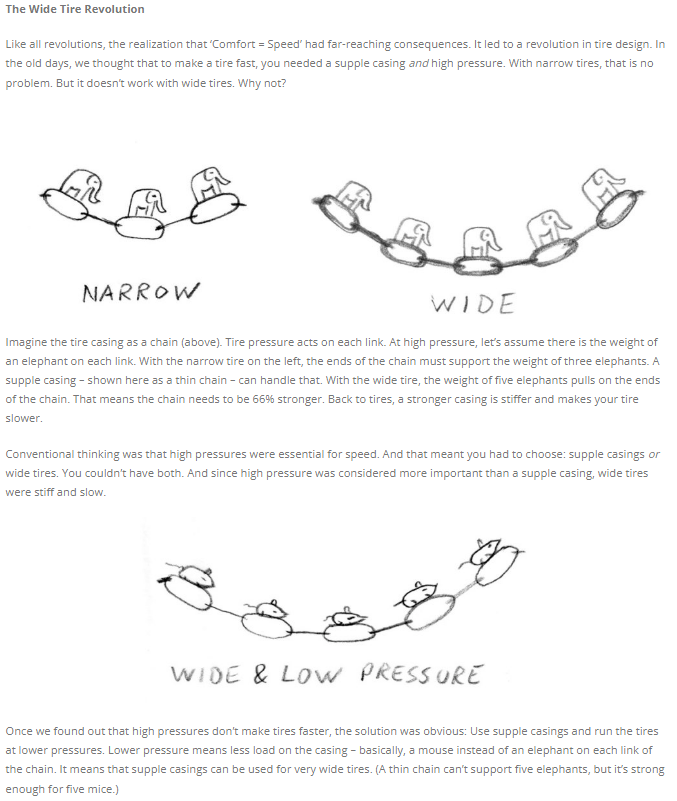
Time will tell if the recently revealed elephant/mouse tire technology will be a game changer.
I don’t think they have the money to out-science the big guys. So their only real strategy is to hit the niches and run with the zeitgeist. Once anyone else is making competitive tire sizes out of their better processes it’s all over.
da what?
Gotta say, my tubeless legers are like rolling on a cloud. Sure seems dangerous and sets up like doing diy tubeless in 2008, but worth it for me on my forever bike. Someday maybe someone will make a ~400 gram 650x48. Until then, reens.
If we use this for tires and the Fizik Bull-Chameleon-Snake for position, we can have a full zoo metric system for bikes within a couple years
dont forget the balance of wag relative to the tail and the dog
Holy shit.
“High pressure doesn’t make tires faster”
No, it doesn’t, but it sure makes rolling resistance less, which makes the power required to go a given speed less which is he same fucking thing most would thing when you say that a tire is faster.
The coolest thing is that they have invented 26 inch knobblies tho ! So Apple.
Tire tests are completely worthless without equalizing sag between tires. Putting all at x% sag before testing is the only real world way to compare tires.
Everyone is still coasting on Berto’s research that sag didn’t vary that much with the dogshit 1980s tires he had so just wing it with pressure. As much as that was true then, it’s certainly not now. The biggest pressure difference at 15% sag for some of the tires I’ve tested has been 30%, which is enough to completely change the interpretation of any rolling resistance results. Nevermind 15% is arbitrary and non-applicable to a wide range of tires.
It would mean
Tire A at 33 psi has a CRR of 33 watts at 24% sag
Tire A at 45 psi has CRR of 25 watts at 15% sag
Tire B at 33 psi has CRR of 28 watts at 15% sag
Tire B at 45 psi has CRR of 26 watts at 5% sag
Guy sees the first two “test results” and in his head thinks “oh I usually ride my tires between 35-40 psi so Tire B is going to be good” but gets the tire and finds out it’s way uncomfortable at 40 psi and the traction sucks. Then, dropping the pressure to get it comfortable is way slow and has weird rebound follow-on effects.
Tire A is always going to be more comfortable at any sag compared to Tire B at same. Nevermind the complete lack of interest in testing spring rate by the big players, infinite spring rate isn’t good - there’s a breakpoint there too.
The problem the BRR guy ran into is that this completely nerfs most of his existent testing and would destroy the already overcomplicated CX/gravel work he’s done. I don’t think anyone else GAF because they’re selling boutique items with the data as a foundational marketing canard, while BRR is selling data itself.
We’re inundated with a lot of numbers and copy but the process of picking a fast tire is almost exactly the same as it’s always been. Are race winners riding it? How much does it weigh? Does it feel fast?
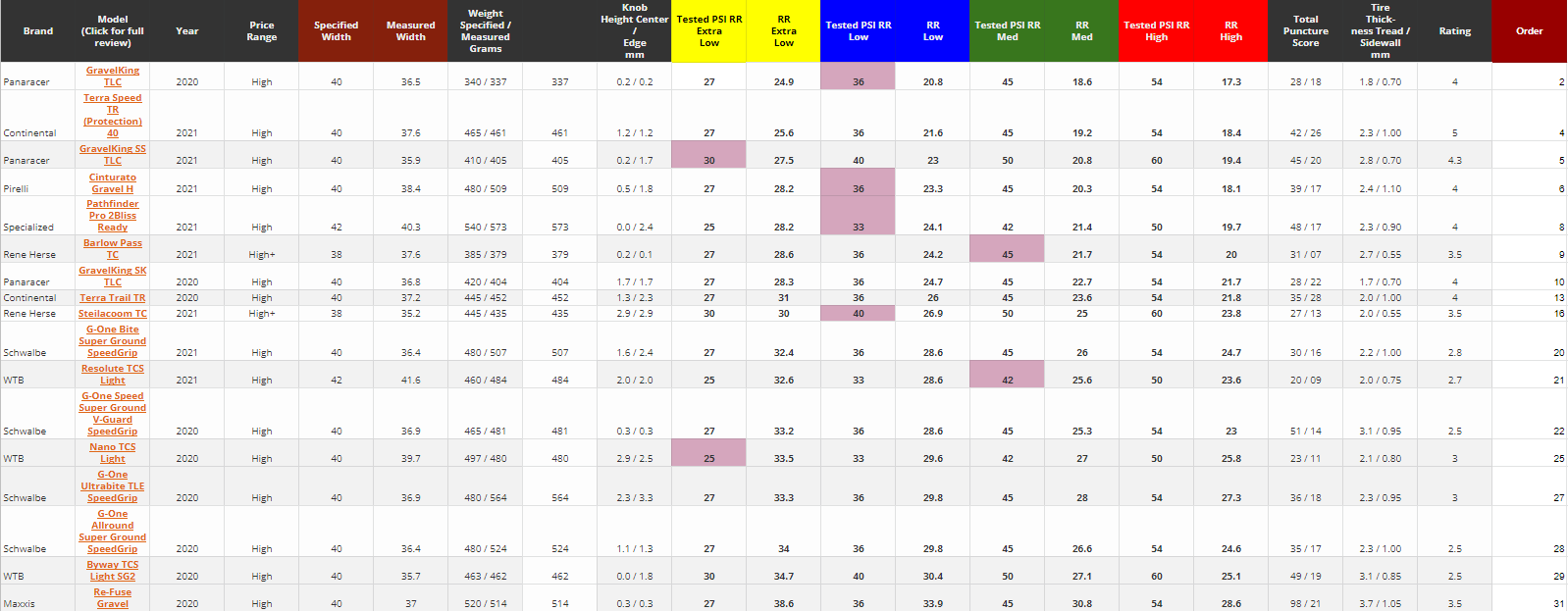
Here’s a link to a dual-purpose spreadsheet I made from the BRR gravel/cx data. I first attempted to apply the PSI at which the tire was tested based on the BRR pressure/width explanation. Then I highlighted each tire’s tested-by-BRR PSI, the closest to at which I found 15% sag.
For example, the Gravelking TLC is overrated and slower than the test would have one believe. Conversely the Barlow Pass is very underrated and would be faster than the testing indicates. The community has been and continues to struggle with updating foundational methodology where 2 psi used to be 2-3% of the measurement but in many cases is now 8-10%.
Addendum: I spent 2021 moving from setting my pressure for max comfort based on the pressure being able to support the sidewall during mildly aggressive cornering - with the thought of research has been that more comfort is going to be faster b/c “vibrations”.
However, what I found was the I am way slow with this framework. As in dropping from 30th percentile in timed events, to 45th percentile. Primarily because, while the body can adapt to a wide range of vibrations wrt to comfort - even short term. The body cannot adapt to putting out 10-20% more watts over the course of a given ride. To put it another way, on one given day - it’s possible to reduce rolling resistance by increasing pressure, while also reducing vibrations by riding light - using positional technical skills - without increasing FTP.
It is not possible, on same given day, to reduce rolling resistance by pedaling harder for longer with lower pressure.